Managing a shipping and transportation business involves far more than just moving goods from one place to another. Behind every successful delivery is a complex web of paperwork, coordination, billing, compliance, and customer communication that must run smoothly every day. Shipping and transportation back office outsourcing has become a practical solution for companies looking to simplify these behind-the-scenes operations without sacrificing accuracy or control.
By choosing back office outsourcing, logistics and transport providers can reduce administrative burdens, improve efficiency, and allow internal teams to focus on core activities like route planning, fleet management, and customer satisfaction, while ensuring reliable logistics back office support across daily operations.
According to Cognitive Market Research, the global logistics business outsourcing market was valued at $1,087.51 billion in 2021. By the end of 2025, the market is expected to grow to $1,285.9 billion. Looking further ahead, projections indicate that the market will reach approximately $1,797.86 billion by 2033. Overall, the logistics business outsourcing market is forecast to expand at a compound annual growth rate (CAGR) of 4.278% from 2025 to 2033, driven by increasing demand for efficient and scalable logistics solutions.
Importance of Shipping and Transportation Back Office Outsourcing
Outsourcing back-office tasks allows shipping and transportation companies to focus on their core competencies, such as logistics and transportation, leading to better service quality and customer satisfaction. Moreover, specialized outsourcing firms are equipped with advanced technologies and skilled personnel, ensuring accurate and timely processing of critical data and documents. This minimizes errors, reduces operational delays, and ensures compliance with industry regulations. Outsourcing administrative tasks in shipping and transportation industry environments is especially valuable where speed, accuracy, and precision are essential.
Additionally, outsourcing back-office functions enables shipping and transportation companies to scale their operations efficiently, without the burden of hiring and training additional in-house staff. Outsourcing partners can provide flexibility and scalability to adapt to changing business demands and seasonal fluctuations. Furthermore, by leveraging the expertise of outsourcing providers, companies can stay updated with the latest industry trends and best practices, and gain a competitive edge in the market.
Finally, outsourcing back office operations also provides cost savings, as it eliminates the need for significant investments in infrastructure, technology, and ongoing maintenance. By opting for a cost-effective pay-as-you-go model, client companies can reduce overall overhead and improve profitability.
Back Office Outsourcing Solutions
Outsourced back office solutions for shipping and transportation include support for documentation, digitization, auditing, scanning of Bill of Lading (BOL), data entry, data processing, freight management outsourcing, and more. Outsourcing back office operations simplifies the overall transportation process and supports supply chain management while strengthening overall shipping operations management.
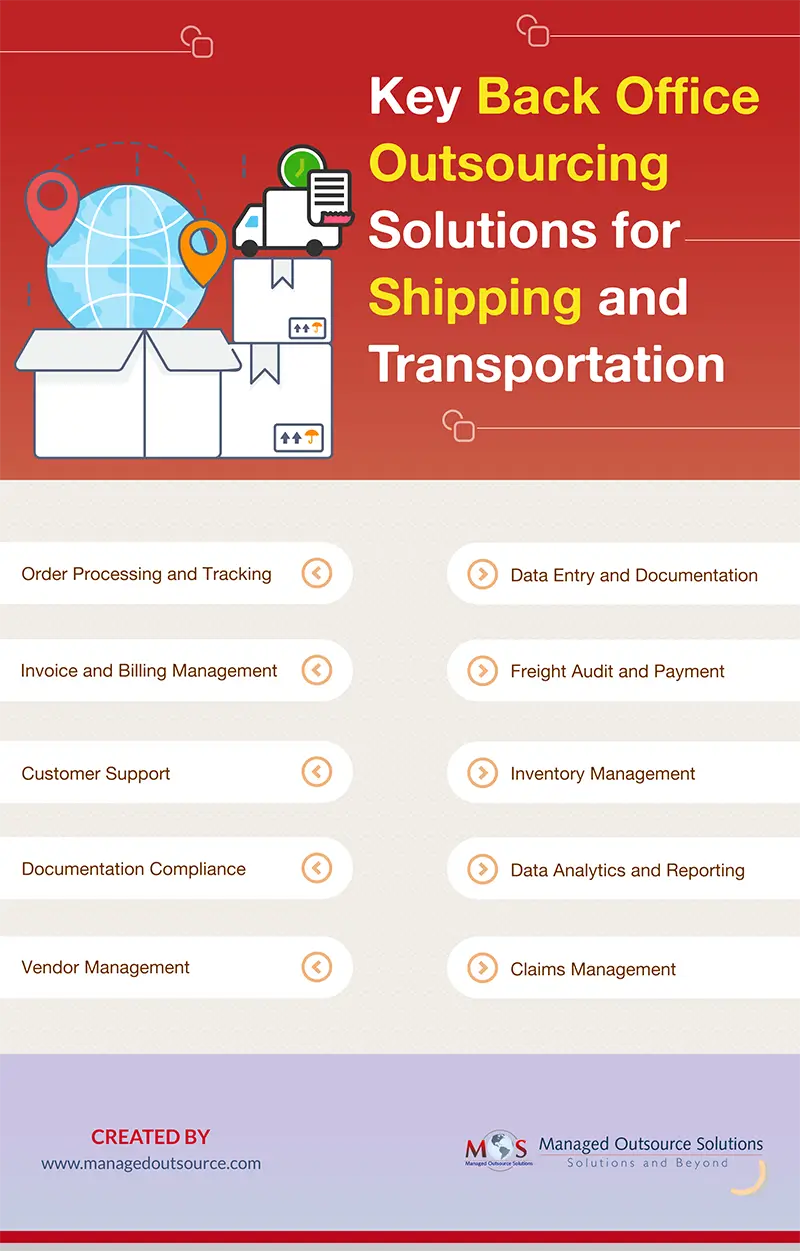
Office outsourcing services for shipping and transportation include the following:
- Generating of Bill of Lading (BOL): A Bill of Lading (BOL) is a legal document that provides detailed information about the goods being transported. Issued as a receipt to the shipper, it serves multiple purposes: it acts as a contract of carriage, acknowledges receipt of the goods, and functions as a document of title, thereby conferring ownership. Outsourcing companies perform BOL tasks related to all four sources for transporting goods including air, rail, sea, and road. Handling paper-based BOL is a tedious task. Outsourced back office solutions including digitizing BOL. An e-BOL can improve productivity and accessibility. As it eliminates piles of paperwork, this is also an environment-friendly option.
- Audit Freight Payment: Many logistic firms are facing trouble handling freight bills. Errors occur due to irrelevant data, leading to inaccurate billing. The frequent modification of freight rates and lengthy procedures are the main reasons for these errors. Outsourcing can ensure proper logistic invoice verification. This can eliminate errors in freight billing. Outsourced solutions also help in the post-audit process by cross-checking the documents, which helps rectify errors in a timely manner.
- Freight Logistics: Logistics companies face many challenges when they transport goods via road, rail, sea or air. Hiring back-office solutions would ease the challenges and simplify freight logistics tasks. It will ensure clarity in managing the supply chain process. Business process outsourcing companies use digital technologies for processing the information which will promote smooth pickup and delivery of products.
- Logistics Data Entry: Logistics data entry is a fundamental process in any industry. Outsourced back office service providers will collect data from different sources including driver logs, BOL, B3 forms, purchase orders, shipping documents, and bills and receipts. They will ensure that all of the data is accurately entered in the company’s database.
Benefits of Back Office Outsourcing for Shipping Companies
Today, more and more logistics firms are relying on outsourcing services for back office operations due to the many benefits they offer. The support of an experienced company can free up their employees and allow them to focus on their core duties.
The key benefits of BPO include:
- High quality, affordable logistics services
- Helps the firm focus on their core functionalities
- Improves customer experience
- Allows for real-time tracking
- Cost-effective
- Provides expert knowledge
- Integrates novel technologies like IoT to speed up processes
- Eliminates tedious paper work
- Improves productivity and efficiency
Role of AI in Shipping and Transportation BPOs
By processing large volumes of data, AI helps identify patterns, predict outcomes, and support smarter decisions across transportation planning, documentation, billing, and fleet coordination. As supply chains grow more complex, AI enables shipping and transportation companies to operate with greater accuracy, speed, and efficiency.
In shipping and transportation BPOs, AI is strengthening several critical areas:
- Automation of Repetitive Tasks
Many back-office tasks in shipping and transportation—such as data entry, freight billing, invoice validation, shipment documentation, and compliance checks—are repetitive and time-consuming. AI-powered automation, often combined with robotic process automation (RPA), can complete these tasks faster and with fewer errors. This reduces manual workload, improves accuracy, and allows staff to focus on higher-value activities like process improvement and exception handling. - Predictive Analytics and Smarter Planning
AI-driven predictive analytics helps transportation BPOs in better decision-making. By analyzing real-time and historical data, AI can forecast shipment volumes, anticipate delays, and optimize routes. This helps shipping companies reduce costs, improve delivery timelines, and respond proactively to disruptions caused by weather, congestion, or global supply chain issues. - AI-enabled Customer Support
AI-powered chatbots and virtual assistants are transforming customer service in shipping and transportation BPOs. These tools can handle shipment tracking requests, delivery status updates, billing queries, and basic support issues instantly. This ensures 24/7 customer assistance, faster response times, and improved customer satisfaction without increasing support staff. - Fraud Detection and Compliance Management
AI also plays a vital role in detecting billing discrepancies, duplicate invoices, and documentation errors. By monitoring data in real time, AI helps transportation BPOs ensure regulatory compliance and reduce the risk of penalties, delays, or financial losses—making operations more secure and reliable.
In an industry where speed, accuracy, and reliability define success, strong back-end operations are just as important as on-road performance. Back office outsourcing helps shipping and transportation companies streamline processes, manage costs, and scale operations with ease, even during peak demand periods.
With the right outsourcing partner, routine tasks turn into efficient workflows that support growth and long-term stability. Ultimately, investing in outsourcing back office operations enables shipping and transportation businesses to stay competitive, responsive, and ready for the future.
Let us handle the paperwork while you focus on moving goods.