
As emerging technologies redefine the landscape of data, privacy, safety, and ethics, they are driving the introduction of intricate regulatory compliance measures. Businesses across industries are grappling with a surge in regulatory updates. A report from leading legal recruitment agency Talyor Root highlights an average of over 200 new regulatory changes per major industry. Interpreting and assessing huge volumes of compliance documentation manually can be a laborious and time-consuming process for compliance teams. Moreover, staying up to date with the exponential growth in compliance regulations is a major challenge. That where AI workflow automation support make a difference.
AI-powered workflows help organizations maintain continuous regulatory compliance by combining automation, machine learning, and human oversight to reduce risk and improve efficiency. This post explains how AI-powered compliance workflow automation improves adherence by enabling smarter, more predictive, and more adaptive document management across highly regulated industries such as healthcare, legal, and finance.
Compliance Challenges in Today’s Regulatory Environment
Complex and frequently updated requirements for regulations like HIPAA, GDPR, or SOC 2 place organizations under constant pressure to stay compliant. New laws, changing industry standards, and evolving data privacy rules require businesses to continuously adjust their processes, documentation, and reporting practices. Keeping up with these changes manually is time-consuming and increases the risk of non-compliance.
Manual compliance processes involve several operational challenges.
- Siloed data: Manual data entry often creates siloed systems where information is scattered across spreadsheets, emails, and disconnected platforms. This leads to “dark data” — data that exists but is poorly organized, hard to access, and difficult to audit. Regulators expect clear, traceable records, and siloed data makes it harder to prove compliance, increasing audit risks and potential penalties.
- Human errors and fatigue: Manual processes can lead to missed deadlines, incorrect data entry, and incomplete documentation. The risk of missing a “red flag” in a sea of 10,000 documents is high.
- Slower processes: In addition, relying heavily on manual processes increases administrative workload, slows turnaround times, and increases operational costs.
- The proactive gap: Traditional compliance is reactive as it looks at what went wrong. AI workflows are predictive, helping to identify and correct issues before they occur.
These compliance challenges impact certain industries quite significantly. In healthcare, providers must comply with regulations such as HIPAA, payer guidelines, and quality reporting standards. In finance, institutions face strict requirements related to AML, KYC, fraud prevention, and data security. Manufacturing and supply chain organizations must adhere to safety standards, environmental regulations, and product quality compliance. Across all these sectors, the growing volume of regulatory demands is making traditional compliance management unsustainable.
How AI Workflow Automation improves Regulatory Compliance Management
AI business process automation improves regulatory compliance management by enabling smarter automation, real-time monitoring, and better risk control.
RPA and AI-Powered Data Entry for Regulatory Compliance
Modern BPO offers access to intelligent or robotic process automation (RPA), which generates cost savings by automating repetitive rule-based tasks such as data entry, verification, and report generation. RPA bots can extract data from multiple sources such as forms, emails, databases, and scanned documents, then enter the information with 99% accuracy into compliance systems, ERP platforms, or regulatory portals. Built-in validation rules help ensure mandatory fields are completed, formats are standardized, and required documentation is attached before submission.
- Automates repetitive processes: RPA handles high-volume, rule-based data entry tasks, while AI adds intelligence through data recognition, validation, and pattern detection. AI-powered document processing extracts structured and unstructured data, which RPA bots then enter into compliance and reporting systems. This reduces the risk of manual errors that can lead to reporting inaccuracies and regulatory violations.
- Helps identify anomalies: Machine learning models help identify anomalies, missing fields, and potential compliance risks before data is submitted. RPA ensures standardized data capture across systems, while AI improves accuracy by learning from historical compliance patterns.
- Supports review and resolution: AI-enabled workflows automatically route exceptions flagged by RPA to compliance teams for review and resolution. Combined AI and RPA automation create end-to-end compliance workflows, from data intake and validation to reporting and audit preparation.
- Maintains audit trails: In regulated industries such as healthcare, finance, and manufacturing, RPA supports compliance by maintaining accurate audit trails, time-stamped records, and process logs. This improve transparency and make regulatory reporting and audits faster and more reliable.
Intelligent Document Processing (IDP)
In healthcare BPO, managing patient records and insurance claims is a high-risk area for manual errors. IDP offers the solution.
- Automated Data Collection: AI workflows automatically collect, organize, and validate audit-related data from multiple systems in real time. On the other hand, manual workflows would require teams to search across platforms, compile records manually, and risk missing critical documentation.
- Validation: AI-powered OCR (Optical Character Recognition) extracts data from medical records and cross-references it against insurance requirements to ensure all “mandatory” fields are compliant before submission.
- Redaction: Automation can automatically mask or redact PHI (Protected Health Information) in documents used for training or non-clinical analysis to maintain HIPAA standards.
Predictive Analytics
- Predicts Risks of Regulatory Violations: Intelligent automation supports predictive analytics using historical compliance data and real-time process information to identify potential risks before violations occur. AI forecasts:
- process bottlenecks
- documentation gaps
- anomalies that may indicate fraud, non-compliant behavior, or operational weaknesses and
- potential for deadline misses
- Improves regulatory reporting accuracy: By forecasting data inconsistencies and submission errors, and flagging high-risk cases for immediate review and intervention, real-time compliance monitoring improves regulatory reporting accuracy.
- Enables smarter workflow routing: By automatically assigning complex or high-risk cases to compliance specialists, AI-assisted processes improve regulatory compliance management.
Manual vs. Automated Regulatory Compliance Workflows
| Feature | Manual Management | Automated Support |
|---|---|---|
| Audit Prep | Weeks of digging through files | Instant, structured report generation |
| Data Entry | High risk of human error/typos | 99% accuracy with RPA and AI validation |
| Regulatory Updates | Relies on staff reading publications | Automatic updates to workflow rules |
| Data Privacy | Manual checks for PHI leaks | Automatic redaction of sensitive info |
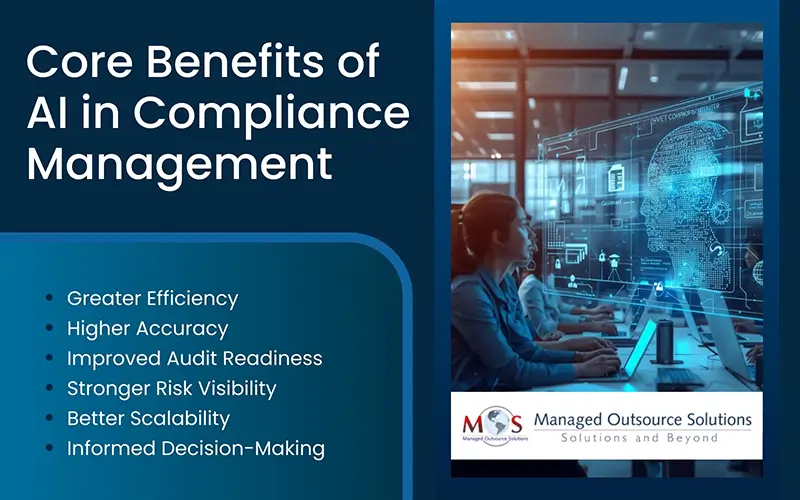
Key Benefits of AI in Compliance Management
AI gives compliance teams the support they need to manage increasing regulatory pressure without slowing down operations. It improves accuracy, reduces administrative workload, and helps organizations stay prepared for unexpected audits or regulatory changes. These advantages make AI a valuable addition to modern compliance programs.
- Greater Efficiency: AI automates repetitive tasks such as data checks, documentation, and control testing. This enables teams to spend less time on manual regulatory work and more time on strategic decision-making.
- Higher Accuracy: AI analyzes large volumes of information consistently, which reduces oversight errors and ensures compliance tasks are completed correctly every time.
- Improved Audit Readiness: AI organizes data, maintains complete logs, and produces audit-friendly reports. This helps organizations stay prepared for internal reviews and external audits at any time.
- Stronger Risk Visibility: AI highlights risks, patterns, and gaps that may not be obvious in manual reviews. This supports faster responses and better control over emerging issues.
- Better Scalability: AI adapts to new requirements without the need for major process changes. Organizations can scale their compliance programs as new laws or standards appear.
- Informed Decision-Making: AI provides advanced insights based on trends and historical data, helping leaders make informed decisions about compliance investments, resources, and controls.
In summary, automated regulatory workflows create a strong foundation for consistent compliance. They help organizations move away from manual, reactive processes and adopt a proactive approach that reduces audit risks and supports long-term regulatory adherence.
AI Supports Compliance Teams — It Doesn’t Replace Them
A common concern is that AI will replace compliance officers. In reality, AI is designed to support and strengthen human teams, not eliminate them. Compliance work involves judgment, ethics, and decision-making — areas where human expertise is essential. Human-in-the-loop oversight ensures critical compliance decisions remain accurate and regulation-ready.
AI handles the high-volume, repetitive “grunt work”, such as data entry, document sorting, rule-based checks, and report generation. This frees compliance professionals to focus on the “nuance work” — interpreting regulations, reviewing complex cases, making ethical decisions, and managing risk strategies.
Instead of replacing compliance officers, AI acts as a productivity partner. It reduces workload pressure, improves accuracy, and allows teams to spend more time on high-value compliance activities that require human insight.
Best Practices for Implementing AI in Compliance Management
Here is a best practices checklist to ensure a structured, secure, and compliant approach to implementing AI in compliance management.
- Define clear compliance goals
- Integrate AI with existing systems
- Ensure high-quality, accurate data
- Use human-in-the-loop validation
- Apply strong data security controls
- Train staff on AI workflows
- Update models for regulatory changes
- Monitor performance continuously
- Maintain audit-ready documentation
- Pilot before full deployment
Today, industries increasingly rely on smart BPO solutions for AI workflow automation. A BPO company offering AI workflow automation helps organizations maintain accurate data through data cleansing services and ensure continuous regulatory compliance by combining automation, machine learning, and human oversight.
Simplify compliance management and boost operational efficiency with AI-driven business process automation.